

There is nothing more romantic than an alternative
Desire: Part III — Escape | On avoidance and attraction
If you’ve ever been in a relationship that is dying a slow death, you will know there is nothing more romantic than an alternative.
Desire is notoriously unfaithful, a merciless companion to waking life. It is often inconvenient, constantly testing us: our willpower, our morals, our commitments. What we repress tends to metastasize. The unconscious builds elaborate escape fantasies that disrupt the even surface of daily life.
Desire can make escape feel like revelation, yet it rarely arrives with clarity as its companion. The pull of immediate desires can obscure deeper ones—the trouble lies in knowing whether our desires are born of avoidance or attraction. Are we moving toward something or merely running away?
In Leslie Jamison’s essay “Daydreamers in Broad Daylight: Ten Conversations” daydreams are framed as portals to desire. She turns to the psychoanalyst Adam Phillips:
“Our lives become an elegy to needs unmet and desires sacrificed, to possibilities refused, to roads not taken,” Phillips writes. “We can’t imagine our lives without the unlived lives they contain.” But I don’t agree with Phillips when he says that “the right choice is the one that makes us lose interest in the alternatives,” and I suspect he doesn’t even agree fully with himself. It’s a delusion—a fantasy of certainty—to think there’s a path that could make anyone stop wondering about the other paths.
It is easy to pathologize this as chronic dissatisfaction, a state antithetical to happiness in which one is perennially disenchanted with reality and lured by escape. But it is also, paradoxically, a way of staying alive to oneself and the world: remaining open to possibility, contradiction, and transformation.

This curiosity—the desire to be consumed and alchemized by experience—has been an animating force of my life. It is not simply a longing to experience more, but an impulse to transcend my own limits: to cultivate experiences like collected stories, to narrativize, understand, and preserve them. It is a kind of pre-emptive nostalgia that compels me to mine life for meaning and beauty—an attempt to reckon with the fragility of time, to stay alive to the fact that every moment is fleeting, and therefore worthy of gratitude, attention, and surrender.
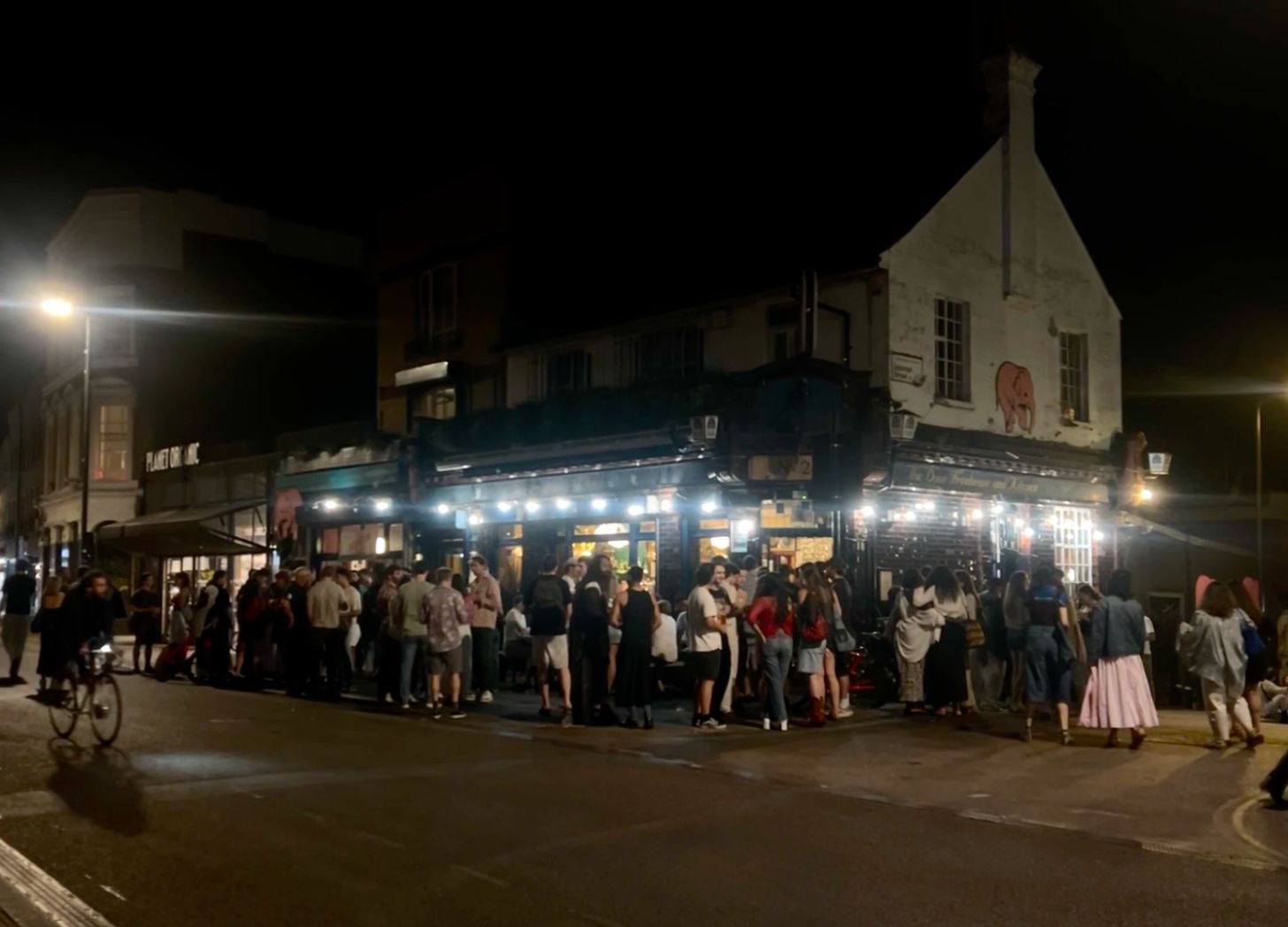
This is what continually draws me to fiction and also makes it impossible to walk past a buzzing pub on a Friday night without wanting to go inside: the warm light gleaming on the cobblestone, the smell of cigarette smoke, the clink of pints of Guinness. It always reminds me of the electric possibility we associate with youth—all the abstract and incarnate longing—for love, belonging, connection, a good time. There is something life-affirming about it. I see strangers overflowing onto the streets talking and laughing, full of unbridled desire, and think: I want to talk to every single one of them.
I wonder if I will ever outgrow this impulse, if it will lose its hold—how I never want to leave the party, but I don’t want to be the last one standing either. I think about how, after dinner at her flat one evening, S told me her theory that people fall into one of two categories: those who arrive at parties with a clear sense of when they will leave, and those who have a hard time knowing when to call it a night. Perhaps this is a kind of litmus test for your relationship to desire—how susceptible you are to its charms. I think part of the reason I love London so much is because people here love to linger. Then, I wonder if lingering is itself a form of presence or escape.
At a launch event for her second novel, I heard Claire Daverley say that regret is the absence of experience, not the presence of unhappiness. I thought of my friends and me: thirty-somethings pursuing impractical passions while doing odd jobs or working freelance, moving through cities like New York and London. Cities where thirties are the new twenties, where the usual markers of adulthood, like settling down, getting married, or buying a home, are delayed or eschewed entirely, whether by choice or circumstance.
I consider whether our tendency to treat life as a series of experiments and experiences is a form of liberation from a prescriptive path—one that bestows insight and a fuller engagement with life. Perhaps there is a kind of humility in recognizing that the self is not something we fully possess or understand, but something we continually encounter and become. Or whether it is something closer to greed: a kind of falling through a trapdoor, overwhelmed by our own openness, seduced by a spectre of alternatives, unable to identify what we actually, truly desire, and choose it above all else. Perhaps this is, in its own way, a fear of commitment. Every choice is, after all, an abandonment of alternatives—a refusal of all the rest.
A line from the short story “Wants” by Grace Paley plays on my mind: “Now, it’s true, I’m short of requests and absolute requirements. But I do want something. I want, for instance, to be a different person.” I think about the impossibility of wanting so much—the blessing and curse of it.
It’s late, but I tug on L’s arm and gesture toward the pub. I think of how our only chance of escaping our own limits, of transcending the self, is in the pages of fiction, in music, in bars, in conversation.
People are clustered together on the curb, their faces luminous against the navy sky, talking and laughing and flirting. Cyclists swarm by. I still find the cacophony of accents in London irresistible. I look at the stylish, eclectically dressed young women: their Y2K Vinted finds, their hoop earrings and air-dried hair, and the men with rolled-up shirtsleeves and singular ear piercings. Each of them with their own stories and desires.
I tell her I want to be where the people are, that the night is still young, that we should go inside. She says she doesn’t know where I get all this energy. I think of another line from a short story, Marina Keegan’s “Cold Pastoral”: “I have this pathetic fantasy that I’d be more productive if I was less attractive,” and I think I have a similarly pathetic fantasy—that I’d be more productive if I were less attracted. Less enthralled by people and pubs and parties, less in pursuit of some elusive thrill. But then I privately counter: there would be no fun in that.
I think about the desire for escape, embodiment, totality. Overwhelming. Wonderful. They want it all—so do I.

My weekend plans involve Saturday night dinner at Dara Klein’s gorgeous, neighbourhood Italian restaurant, Tiella (I went once after Gillian Orr mentioned it in her Substack and have been dying to go back!), followed by watching the World Cup at a pub. While I am entirely ignorant when it comes to matters of sport, as you will have learned from the essay above, people, parties, and pubs are my weakness, so far be it from me to say no to an opportunity for camaraderie. On Sunday, my cousin and I are heading to Bath for a spa weekend escape of sorts—fittingly on theme.
I read a lot of essays this week that happened to be about drinking. My favourite was “Is This the End of Booze?” by Derek Thompson. I also liked “A Diehard Drinker Accidentally Quits” by Sarah Miller.
See you next Sunday for Desire: Part IV. You can find the full series here. Until next time, go linger at a pub.
Tried to go back to Tiella for Friday lunch but they only do weekend lunchtime service - was so sad!
What a beautiful set of musings. I really felt this post in my soul! The impossibility of everything can be beautiful but melancholy and you capture that here. Thank you so much for quoting my line on regret, also. X